
Robot hands that feel.
Five-finger hands and curving, sliding cables solved together at a fixed 2 kHz. Every fingertip reads the force it actually receives, maps it across its pad, and flags the moment a cable starts to slip.
Demo · 2:19. Dexterous hands carry a cable's weight, inertia and friction. Then one recorded run is replayed exactly in MuJoCo, Isaac Sim and LeRobot.
This video is a simulation. Every frame comes from the OpenBeam physics engine, not real hardware. The live demo goes further than the video, including rack installation, removal, maintenance and repair.
What OpenBeam adds to your simulation stack
OpenBeam works alongside MuJoCo, Isaac Sim and LeRobot. Record a run in OpenBeam and replay it in the tools you already use.
Touch you can trust
OpenBeamEach finger's contact is a row of the cable's own implicit solve, coupled to that finger's body. Touch is the force each phalanx actually receives, read every 0.5 ms, and each fingertip pad carries an 81 × 81-cell force map over 40 mm.
Your current stackGeneric simulators sum soft contact in a volume or compute touch after the step.
Cables that carry load
OpenBeamThe cable is a strand, not a spline, and nothing is animated. Its weight, inertia and friction load the fingers, and it slides across curved finger surfaces, not faceted mesh contact.
Your current stackOpenBeam's soft-body cables also run as plugins for MuJoCo 4.0, NVIDIA Isaac Sim 6.2 and LeRobot 0.7, with beam-theory checks.
Grip and slip, labeled
OpenBeamFriction is modeled at the fingertips, and contact windows are labeled holding or sliding. In the cable pinch, no slip was flagged in 70 holding windows, and slip was flagged in all 10 sliding windows once the pull reached the 3.96 N friction limit.
Your current stackOpenBeam plugs into the tools you already use. It doesn't replace Isaac Sim or your sensor simulation. It adds the contact physics: friction, slip and where the load lands on each fingertip.
Production hands, imported unchanged
OpenBeamThe Tesollo DG-5F and the Sharpa Wave come straight from their public URDFs through OpenBeam's robot importer, with servo-driven finger joints.
Your current stackThe same public URDFs your team already uses.
Failure telemetry
OpenBeamForce, stress and contact state on the same clock as the pictures, with telemetry for nodes, beams and broken beams.
Your current stackVideo and poses alone don't carry the force, stress and contact state behind the motion.
Record once, replay everywhere
OpenBeamEvery 0.5 ms step is recorded and exported, including a LeRobot v3 dataset.
Your current stackMuJoCo and Isaac Sim replay all 40,863 steps of the run and match OpenBeam's hashes exactly. LeRobot plays it back from the dataset.
Hosted, driven by agents
OpenBeamOpenBeam Cloud runs in a browser, with no local GPU.
Your current stackWorks with the AI agents you already use: they drive OpenBeam over MCP to load scenes, send controls, run tests and read telemetry.
The numbers behind the demo
Fingertips up close
Two short clips from the engine, each with the forces it measured. Every frame is simulated.
Fingertip touch: force maps, grip and slip
Fingertips do the fine work, so OpenBeam reads them on their own. Each fingertip pad reports its own load, and a pad can carry a force map of 81 × 81 cells over 40 mm.
- A three-fingertip grasp. On an LC connector, the hand closes until each fingertip feels contact. Each digit holds its position on first touch, and a second fresh reading confirms contact. Index and middle then regulate toward 2.0 N per tip while the thumb holds its position. In the hold, the thumb read 3.35 N and index and middle 1.65 N each. When the hand opens, every reading falls to zero.
- Pulling against a clamped cable. The Sharpa Wave curls around a hanging power cable, and its green fingertip pads report their own loads. Pulling against the cable clamps, the little finger carried the largest fingertip load in the run, up to 338 mN, with a cell peak of 5.9 mN on its force map.
- Touch stays on the same sensor cell. In a sensor-frame test at 2 kHz, a loaded fingertip turns through 90° over 31 mm of travel at a 50 mm/s slip speed. The contact stays on one pad cell, row 13, column 1, at about 2.0 N. The prescribed contact reverses direction halfway, so mean shear cancels while the sensor still reports sliding.
- Sensing when the cable starts to slip. A cable is pinched between two opposing fingertip pads, and the cable solver increases the pull on one end. No slip was flagged in 70 holding windows. When the pull reached the 3.96 N friction limit, the cable slid, both pads detected the transition, and slip was flagged in all 10 sliding windows.
Dexterous motion: real hand models, real contact
Generic simulators sum soft contact in a volume or compute touch after the step. In OpenBeam, each finger's contact with the cable is a row of the cable's own implicit solve, coupled to that finger's body.
- Production hands, imported unchanged. The Tesollo DG-5F (five fingers, 20 joints, all driven) and the Sharpa Wave (16 of its 22 joints driven) come straight from their public URDFs through OpenBeam's robot importer. Hook grasp and palm carry.
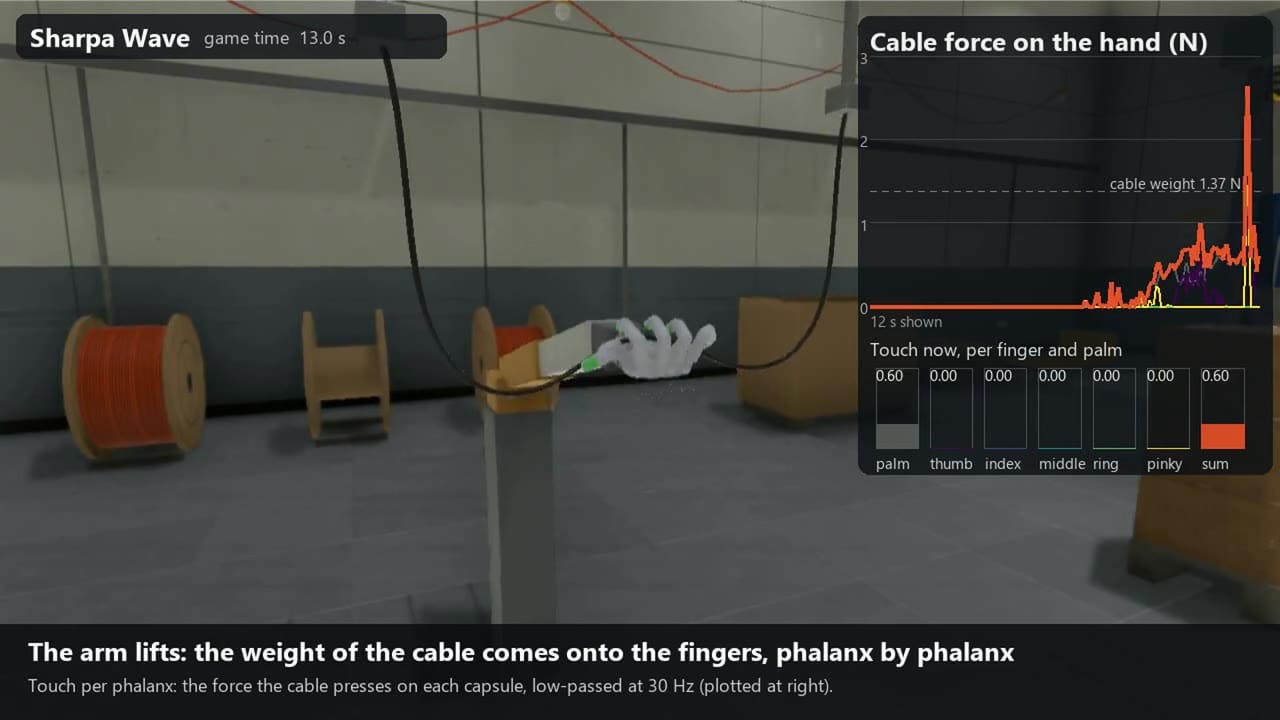
- Touch per finger, every 0.5 ms. As the arm lifts, the cable's weight comes onto the fingers phalanx by phalanx. The readout is the force each finger actually receives, for the palm, thumb, index, middle, ring and little finger, so you can see how much of the load sits on the fingertips and how much on the palm.
- Two-way contact. Servos drive the finger joints. The cable loads each finger link, and the arm feels it. When the arm holds still the cable swings on, and the fingers feel that too. When the fingers open, every reading falls to zero.
Curvilinear motion: cables that sag, curve and slide
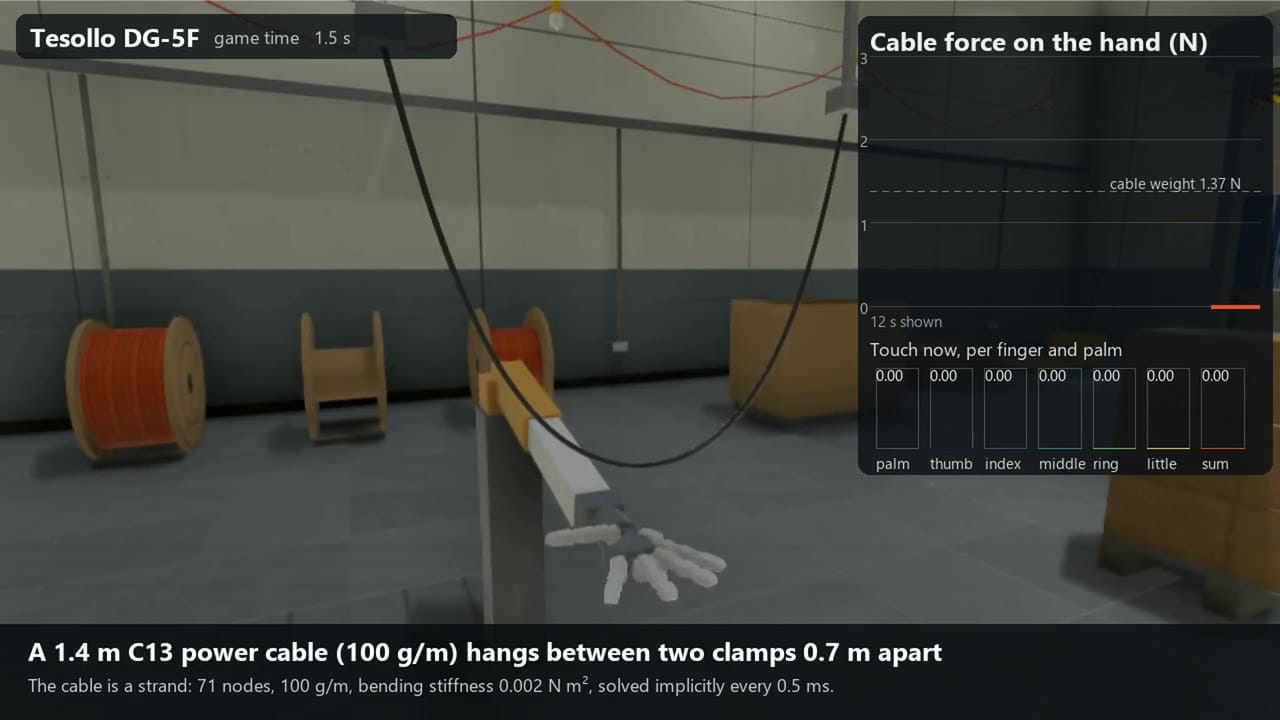
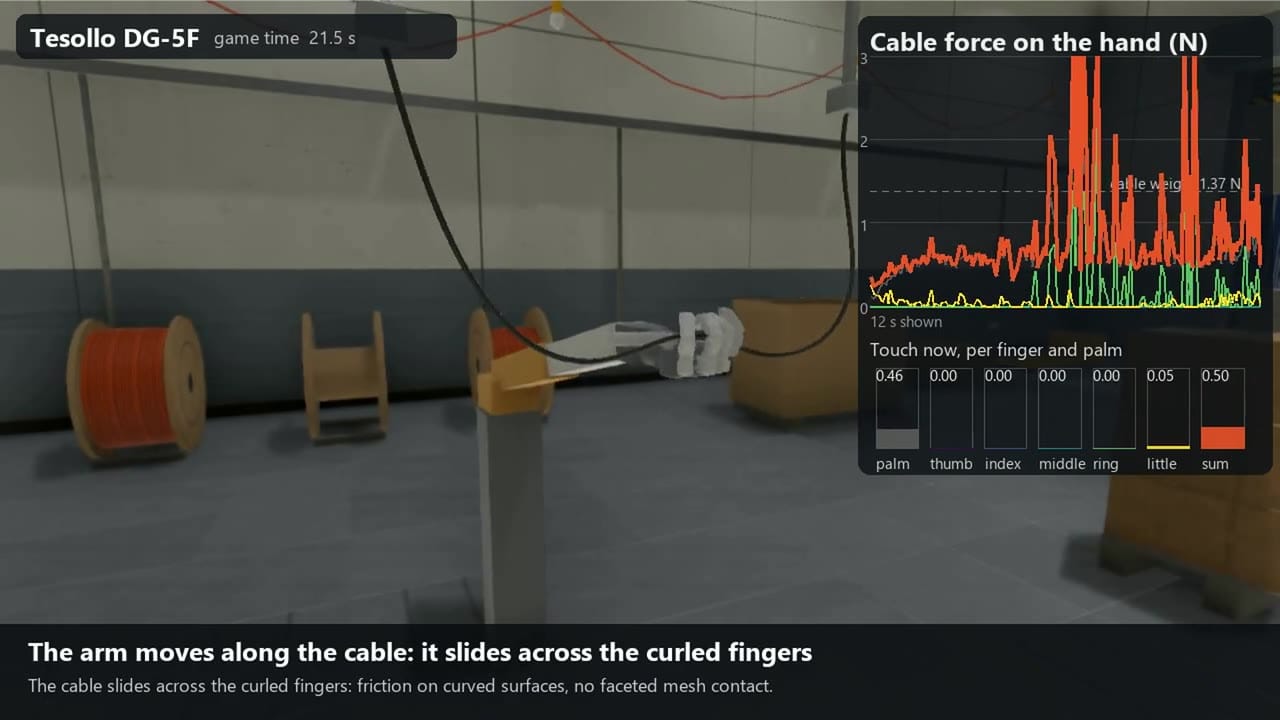
Nothing is animated. The arm moves, and the cable's shape is the physics. It hangs in a natural curve, slides across the curled fingers and settles where the forces balance.
- The cable is a strand, not a spline. In the demo a 1.4 m C13 power cable is 71 nodes at 100 g/m, with a bending stiffness of 0.002 N m². It's solved implicitly every 0.5 ms, with its mass, bending, inextensibility and friction.
- Fingers are smooth shapes. Each phalanx is a capsule and the palm a box, fitted to the hand's mesh. A cable slides along curved surfaces instead of catching on mesh facets.
- Contact lives inside the solve. Each finger's contact is a row of the cable's own implicit solve, coupled to that finger's body. Force flows both ways, from the cable into the hand and from the hand back into the cable.
- Bend, twist and permanent set. In OpenBeam's data-centre cable model, copper conductors yield past a set bend radius and twist elements keep a coiled cable from rolling over. On a 120 mm spool, the kept coil measured 243.8 mm, against 242.4 mm from an independent fibre-section model.
One run, every stack: MuJoCo, Isaac Sim and LeRobot
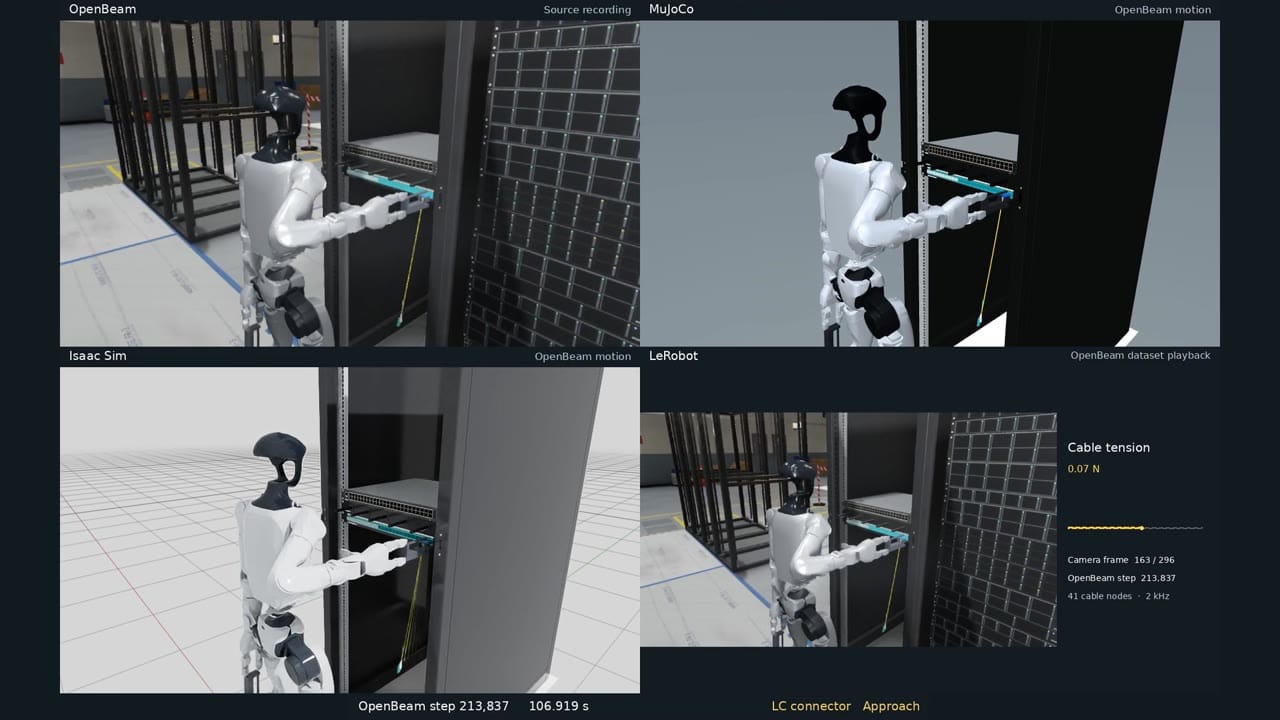
A humanoid plugs an LC connector into a switch. OpenBeam steps the robot, the connector and a 41-node cable at 2 kHz, and records every 0.5 ms step: each node's position and velocity, the grip and the socket state.
MuJoCo and Isaac Sim replay all 40,863 steps and check the cable's position and velocity against hashes from the OpenBeam recording. Both match exactly. LeRobot plays the run back from the exported LeRobot v3 dataset.
What you'll see in the live demo
- A three-fingertip grasp on an LC connector, with index and middle regulated toward 2.0 N per tip.
- A cable pinched between two fingertip pads and pulled until it slips, with holding and sliding flagged as it happens.
- Hands carrying a cable, with live force charts for each finger and the palm.
- A cable sliding across curled fingers, then released, with every reading back to zero.
- A humanoid plugging an LC connector into a switch, recorded at 2 kHz.
- The same run in MuJoCo, Isaac Sim and LeRobot, hash-checked step by step.
- OpenBeam Cloud in a browser, with no local GPU, driven by an AI agent over MCP.
What's simulated, and what isn't
Simulated. The cable's mass, bending, inextensibility and friction. Finger joints driven by servos. Two-way contact, with touch read per phalanx and per fingertip pad, and holding or sliding flagged at the fingertips.
Stand-ins. A generic carrier arm. Capsule and box contact shapes, not the meshes. The grasps are scripted, not learned. Sharpa abduction is locked. The sensor-frame test uses prescribed fingertip motion, and the slip test pinches the cable between two pads rather than a full hand.
Next. Pulling a cable through a full-hand grasp, and how its weight splits between the fingertips and the palm. This work is in progress and not part of the demo.
Papers, code and people
- Paper · arXiv 2602.21625Tacmap: Bridging the Tactile Sim-to-Real Gap via Geometry-Consistent Penetration Depth MapSu, Peng, Ren et al. Background reading on fingertip tactile maps from penetration depth.
- Open source · GitHubOpenBeam sim pluginsSoft-body cables as plugins for MuJoCo 4.0, NVIDIA Isaac Sim 6.2 and LeRobot 0.7, with beam-theory checks.
- DocsOpenBeam MCP toolsLoad scenes, send controls, run tests and read telemetry from an AI agent.
- Founder & CEOBeshoy Hanna on LinkedInHappy to walk through the demo.
- CompanyOpenBeam on LinkedInDemos and release notes as they land.
- X and YouTube@openbeamworldShort clips from the engine, on X and on YouTube as @openbeamworld.
See it live.
Bring your hand, cable or connector task. We'll show you the forces behind it.