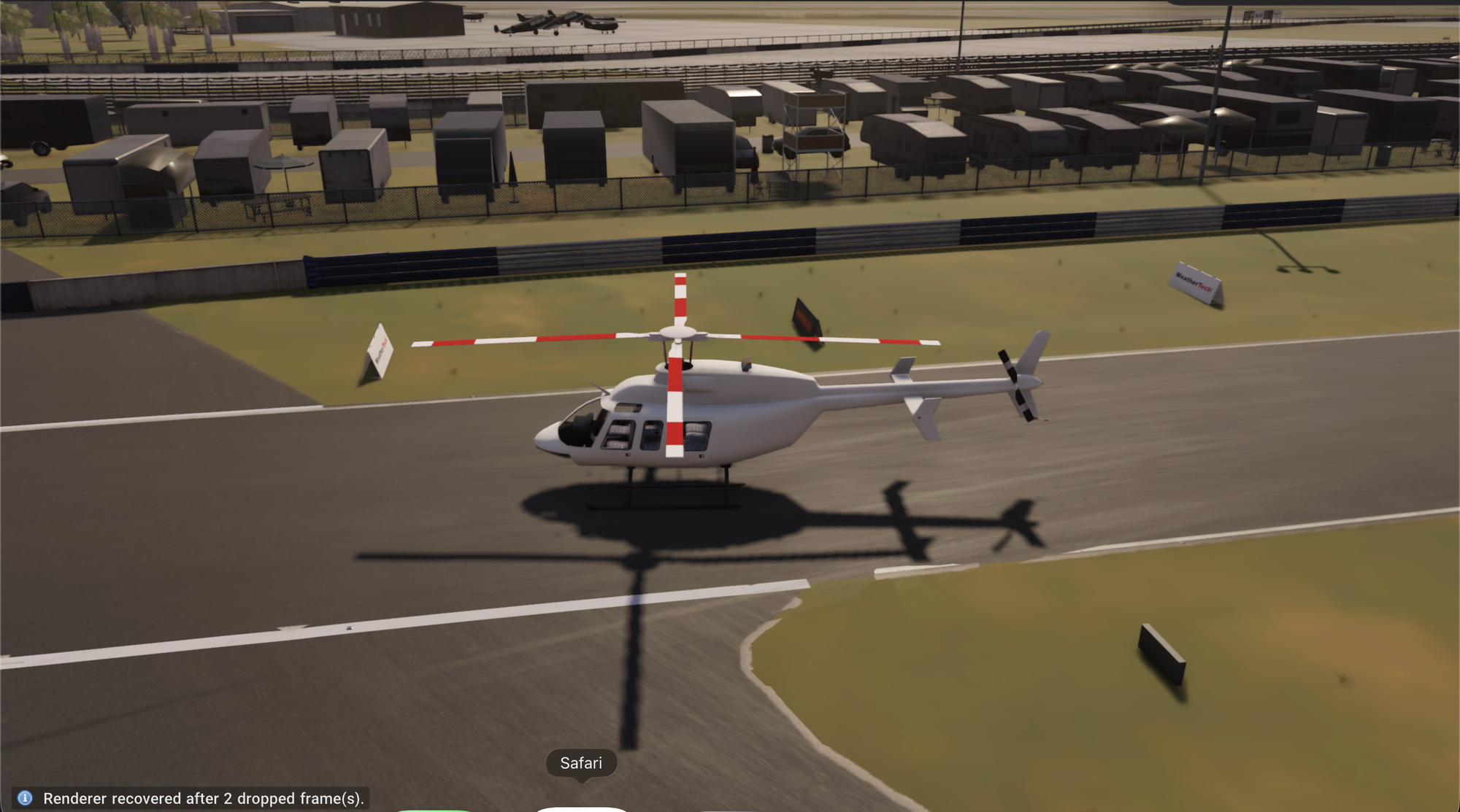
Record a run and download its data
Record a session with the video, your controls and the engine data on one clock, then watch it or download the data bundle.
A recording keeps three things from your session on one clock: the video, every input you send (keys, mouse, gamepad) and the engine data the game reports. Recording runs alongside the game, so it never slows the simulation or the stream.
Record
- In the player, move the pointer to the top of the tab and choose Record. The button shows that it is recording.
- Choose it again to stop and save. A recording also stops when the session ends; what it holds is saved.
A recording stops on its own before its video reaches 8 GB, or if the stream changes size or codec. Everything up to that point is kept.
Find your recordings
- In the player: open Content. Recordings are listed under This session and Earlier session.
- On the dashboard: open Recordings. Each recording appears once it is saved.
From either list you can play the video and download the data. On the dashboard you can also delete a recording, which removes its video and data from storage for good. The video can take a moment to become available after you stop recording.
What the download contains
The video, preview.mp4, is the stream's own frames at the session's frame rate, saved without re-encoding. The data bundle is a .zip with these files:
| File | What it holds |
|---|---|
recording.json | The codec, the clock, counts of frames, inputs and engine samples, anything that was dropped, and why the recording stopped. |
frames.jsonl | One line per video frame: its index in preview.mp4, its time t_ns, whether it is a keyframe, and any frames lost before it. |
input.jsonl | One line per input event: its time, the frame it arrived during, and the event (key, mouse move or button, scroll, text, gamepad or touch). |
engine.jsonl | The engine samples the game sent, each with the frame it belongs to. |
manifest.json | Each file's size and SHA-256 checksum, the video included. |
Line the tables up
Join the tables on t_ns. A frame's time is when it left the encoder, so its picture shows the game about a frame or two earlier. Frames arrive about 16.7 ms apart at 60 fps, give or take about 10 ms; smooth the timeline yourself if you need even spacing.
An AI app connected over MCP can also start and stop recordings. See OpenBeam MCP tools.